


The DOT (Department of Transportation) is a well-known organization in America. Most people know it oversees things like public roads, transportation, and roadway compliance. But have you ever wondered, “What’s a DOT number?”
A point of confusion for many in the transportation or hauling industry, a DOT number enables the government to track safety and compliance in commercial vehicles.
What seems like a straightforward principle can become confusing when applying specific rules and regulations. This leaves many businesses and independent operators wondering if a DOT number is required to stay compliant.
At DRS, we see the frustration from many of our roll-off and waste hauling operators when trying to understand DOT numbers. Between learning the requirements, how to apply, and what it takes to stay compliant, there are a lot of misconceptions that could cost serious time and money.
Keep reading to learn “what’s a DOT number?”, including who needs one, when it’s required, how to get a DOT number, and common misconceptions surrounding the topic.
TL;DR Summary
- A DOT number identifies commercial carriers and tracks safety and compliance.
- A DOT number is required for certain vehicles, cargo types, and interstate operations.
- Dumpster rental, waste hauling, and construction businesses commonly need DOT numbers.
- DOT numbers must be displayed on vehicles and kept up to date.
- Ongoing DOT compliance supports safe operations and business growth.
What is a DOT Number?
DOT Numbers are used to identify commercial motor carriers, and to track safety, inspections, and compliance.
While they are called “DOT” numbers, they actually aren’t issued by the Department of Transportation; USDOT numbers are issued by FMCSA (Federal Motor Carrier Safety Administration).
Why the FMCSA? The FMCSA runs the trucking program within the DOT. With the FMCSA handling trucking companies, commercial safety, driver compliance, and inspections, it’s a strong fit for issuing DOT numbers. It’s still called a DOT number because DOT is the parent agency and holds the top-level authority for writing the rules and handing off enforcement.
When a truck is inspected, involved in a crash, or audited for compliance, that data is compiled in federal databases under the carrier’s DOT number. This helps FMCSA spot patterns of bad behavior, provides a searchable history for law enforcement and inspectors, and helps vendors evaluate a company’s reputation before conducting business with them (usdotdata.com).
What a DOT Number is Used for
A DOT number is mainly used for identification and tracking. Here’s a closer look at how a DOT number is used.
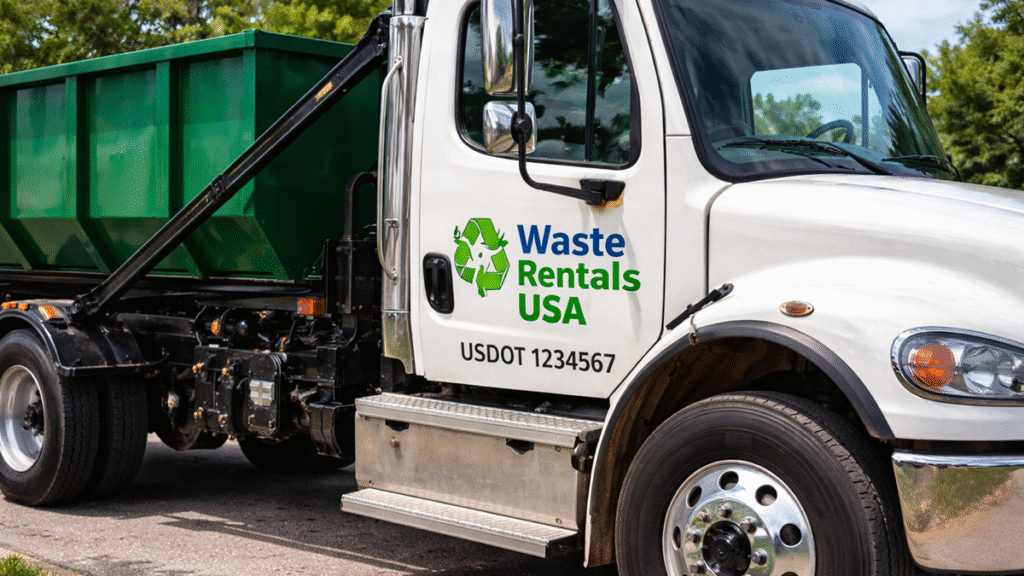
- Identifying Commercial Motor Carriers: A business that uses large trucks (i.e. over 10,000lbs GVWR), transports passengers or hazardous materials, or engages in interstate transportation, must register its vehicles for a DOT number (FMCSA). This number becomes a unique ID, identifying all vehicles and operations from one entity. Once a DOT number has been issued, all vehicles must display the number in a highly visible area like on doors or the truck cab.
- Tracking Safety Records, Inspections, and Compliance: When a truck is inspected, involved in a crash, or audited for compliance, that data is compiled in federal databases under the carrier’s DOT number. This helps FMCSA spot patterns of bad behavior, provides a searchable history for law enforcement and inspectors, and helps vendors evaluate a company’s reputation before conducting business with them (usdotdata.com).
Where a DOT Number Appears on a Vehicle
Where the DOT number appears is crucial, allowing inspectors and law enforcement to easily document and act on that number when necessary.
Proper placement of a DOT number could save you time and prevent violations. The consequences of missing or improper placement can result in fines over $1,000 or timely inspections. Worse yet, improper or incorrect DOT number markings can leave you vulnerable to an “out of service” order, instantly grounding your vehicle until the situation can be resolved.

To stay compliant with the DOT and FMCSA, you’ll want to follow these guidelines for placing your DOT number on a vehicle:
- Display numbers on both sides of the vehicle (doors are standard).
- Must include the carrier’s name and “USDOT” followed by the number
- DOT numbers must be visible from 50 feet away, in letters at least 2 inches tall.
- A contrasting color must be used. If the truck is black, the letters should be white.
When do You Need a DOT Number?
Now that we’ve answered your question, “What’s a DOT number?”, it’s important to know when you need a DOT number.
Applying for a DOT number when it isn’t necessary can waste countless hours, and in some cases, money.
While exceptions may apply and requirements vary state by state, these are the most common reasons for needing a DOT number.
Vehicle Weight Requirements
A DOT number is typically required if a vehicle, or vehicle/trailer combo has a GVWR of 10,001lbs or more. GVWR means Gross Vehicle Weight Rating, and is a value set by the vehicle manufacturer.
GVWR is based on the capacity of the frame, suspension, axles, brakes, and tires, and can usually be found on the manufacturer’s sticker, registration paperwork, and vehicle specs.
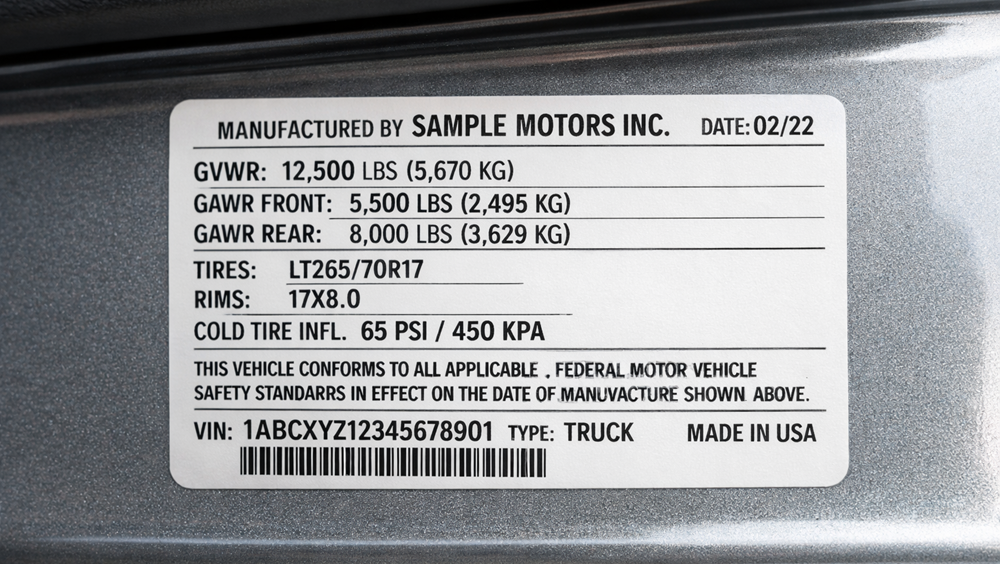
There is also GCWR (Gross Combined Weight Rating) which applies to a vehicle plus trailer. This also carries a 10,001lbs requirement.
Why does GVWR or GCWR matter for a DOT number? Because under federal rules, once a vehicle exceeds 10,001lbs it becomes a commercial motor vehicle (CMV), falling under DOT requirements for registration, inspections, and safety compliance.
Commercial Driver’s License (CDL) requirements often overlap with DOT number regulations. Learn more about CDL requirements in the dumpster rental and hauling industry.
Interstate vs Intrastate Operations
Operating across state lines (known as interstate commerce) is a factor requiring a DOT number.
Whether hauling goods destined for another state, or crossing state lines while conducting business, interstate commerce will likely require a DOT number.
While intrastate commerce isn’t always a factor, some states do require DOT numbers for intrastate hauling.
According to documentation from FMCSA, many states still require a USDOT number even when only conducting business within state boundaries. Some of these states include Texas, Florida, Alabama, California, and Pennsylvania (additional states are listed in the documentation).
Type of Cargo Being Hauled
Cargo plays a major role in determining DOT number requirements.
Hauling equipment or materials using heavy vehicles is considered commercial activity, leaving it open for regulation by federal and state governments.
Transporting the following cargo types fall under DOT regulation:
- Construction Debris: Debris like drywall, concrete, roofing materials, and dirt are considered commercial cargo.
- Waste: Whether from a home, jobsite, or commercial property, waste hauling almost always falls under DOT oversight. This is sometimes overlooked by startup dumpster rental businesses, as well as businesses conducting junk removal, residential trash, and hazardous waste removal.
- Recyclables: Moving recyclable materials as part of a service likely requires a DOT number.
- Misc. Materials: Any paid service (i.e. junk removal) to move materials, whether the materials are new, used, or disposable, is viewed as “materials for hire”.
What Types of Businesses Typically Need a DOT Number?
DOT numbers are utilized in hauling, material delivery, and transportation businesses. With a variety of niches within these industries, you’ll have to analyze your business’s vehicles, cargo, and travel requirements before deciding if you need a DOT number.
Keep in mind that the organization size doesn’t matter here. Whether a company has one truck or a massive fleet, a DOT number may be required.
Let’s break down some of the most common business types that carry DOT numbers and why:
Construction Hauling
Heavy trucks that move dirt, gravel, equipment, or building supplies often need DOT numbers. It’s common for large construction hauling vehicles to exceed weight thresholds and to be used in commercial job-site operations, an area of DOT oversight.
Waste Hauling & Dumpster Rentals
Dumpster rental and waste hauling routes may stay mostly local, but multiple factors influence the need for a DOT number:
- Roll-off and hook-lift trucks can exceed the 10,001lbs GVWR threshold.
- The transportation of materials or debris to/from landfills and job sites.
- Add-on services like delivering/retrieving portable toilets qualifies as a commercial operation and can push vehicles over the 10,001lb threshold.
- Commercial operations may be conducted as part of doing business.
Landscaping & Material Delivery
Larger landscaping operations haul mulch, stone, soil, equipment, or yard debris. If vehicle weight limits reach above 10,001lbs GVWR, or materials are transported commercially, a DOT number might be needed.
Freight & Transportation
These companies are most associated with DOT numbers. Moving goods, often across state lines, and using commercial trucks that easily exceed 10,001lbs GVWR present a need for safety, compliance, and tracking.
DOT Number vs. MC Number: What’s the Difference?
If you’re wondering “what’s a DOT number?”, then you might not know what an MC number is either.
While a DOT number applies to businesses even when hauling their own materials and working in-state, a MC (Motor Carrier) number is generally required only when companies transport goods for-hire across state boundaries.
Carriers will almost never require an MC number and NOT a DOT number but may require a DOT number and NOT an MC number. It’s also common to need both an MC and DOT number. This table helps clarify the different scenarios where a DOT and/or MC number are required.
| Situation | Need DOT Number Only | Need DOT & MC |
| Hauling your own containers or debris | Yes | No |
| Operate locally/intrastate | Yes | No |
| Hauling materials for other companies | No | Yes |
| Transporting regulated freight across state lines | No | Yes |
| Operating as a for-hire carrier | No | Yes |
How to Apply for a DOT Number
Many would be surprised to find that applying for a DOT number is free. But this doesn’t mean the process is always simple.
Applications are submitted online through the FMCSA, and there is no fee to apply. If you’re still unsure if you need to apply, you can use the FMCSA’s “Do I need a USDOT Number” tool found here.
For most, the application process takes around one hour, and a DOT number is provided immediately upon finishing the application.
If you have the information ready before beginning the application, the process will go much smoother. Here is the information typically required when applying for a DOT number.
- Business Details: Your legal business name, business address, contact info, and EIN (employer identification number) or social security number.
- Vehicle Information: Number of vehicles in operation, types of vehicles (body type including truck, van, etc.), and whether they are owned or leased. You’ll also be asked about vehicle weight classes, so have that info ready (remember you can find this on the manufacturer’s info sticker inside your vehicle).
- Type of Operation: How does your business operate. This includes information like how you transport goods, whether you haul goods for your own business or a 3rd party, and the types of cargo carried.
What Happens After DOT Approval
DOT number carriers must maintain compliance going forward. Compliance is focused on federal regulations including:
- Keeping driver qualification files
- Maintaining vehicle inspection and maintenance records
- Completing periodic inspections
- Readiness in case of audit or roadside inspection
Some companies may also be subject to a New Entrant Safety Audit within the first year of operation.
What’s a DOT Number – The Breakdown
A DOT number helps avoid fines and downtime, while keeping your business compliant for normal operation and expansion.
While the process may seem unnecessary to some, its intent is to protect carriers, equipment, businesses, and other drivers on the road.
Compliance measures like DOT and MC numbers are a crucial part of running a scalable, professional hauling business. To help streamline operations, reduce risk, and set your business up for success, consider a software solution like Dumpster Rental Systems (DRS).
With features like inventory tracking, advanced routing tools, and automated reports, your equipment rental or waste service business can stay compliant, operate more efficiently, and scale with confidence.
Schedule a free DRS demo for a closer look at our leading software, apps, automation tools and marketing services.
Frequently Asked Questions
If I only operate locally, do I need a DOT number?
If you are hauling commercially, transporting qualifying cargo, and operating with a vehicle over 10,001lbs GVWR or GCWR you will likely need a DOT number, even if you only operate locally.
Do I need to update my DOT info with business changes?
Yes, anytime your business grows it’s smart to review your DOT profile. If you’ve made any changes including business name, contact info, changes in ownership, adding/removing vehicles, or cargo being hauled, you’ll want to update your DOT profile. Even if no changes are made, you are required to update your information once every 24 months.
Can you be DOT certified without a CDL?
Yes, you can have a DOT number without a CDL or CDL-carrying driver. A CDL is not required if a vehicle is under 26,001lbs GVWR, does have haul hazardous materials, and is not designed for transport of 16 or more passengers. While these requirements might overlap with DOT requirements in some cases, it’s not always a given.
What does “dot certified” mean?
There is no official DOT certification, so “DOT certified” usually means one of three things. Either a driver or company has a valid DOT number, has passed state vehicle inspections, or has received a certification as a medically certified driver.
Can I apply for a MC number without a DOT number?
No. A DOT number is required before being issued an MC number, allowing the FMCSA to tie MC authority to an existing DOT record.
The information in this article is for educational purposes only and should not be considered financial, business, or legal advice. Certification requirements can vary widely based on location, business size, operations, and requirements. Always do your own research and consult a qualified professional or government agent before making any decisions regarding your business operations.