TL;DR
- Tipping fees are an ongoing cost for dumpster rental businesses can have a major impact on profit margins
- The latest EREF data shows tipping fees are rising overall, though inflation seems to be driving most of the increase
- Costs still vary widely by region, landfill size, and disposal site, making local tracking essential
- Operators can protect margins by negotiating rates, choosing disposal sites strategically, and using software to track costs
Tipping Fees: The Basics
If you own a dumpster rental business, tipping fees are a daily reality and are a big financial consideration for your operation.
Tipping fees (also called “gate fees” or “disposal fees”) are charges paid by waste haulers to dispose of waste at a landfill or other waste management facility. These costs are usually price by weight, with per ton charges being the most common unit.
Tipping fees can vary widely between regions, states, and even counties within the same state. This variation is due to factors such as landfill operating costs, local environmental regulations, and municipal policies.
How Tipping Fees Affect Your Bottom Line
Because you will not be able to dispose of waste and debris without paying landfill tipping fees, they have a major impact on your dumpster rental business. Tipping fees are ongoing costs of your business operation, so they determine your profit margin from each haul and should be a key factor in determining dumpster rental price points. So, a business owner who is not optimizing their tipping fees could be losing money in the form of higher overhead costs and underpriced rates.
Key Tipping Fee Insights from the 2025 EREF Report
The Environmental Research and Education Foundation (EREF) is a leading agency focused on municipal solid waste and construction and demolition disposal fees. Each year, EREF releases a comprehensive report on tipping fee trends across the U.S. The 2025 report includes data collected from over 300 landfills, showing tipping fee changes and variation by region, landfill size, and ownership model1. It provides a detailed overview for dumpster rental business owners on how market conditions and economic shifts are affecting tipping fees.
Continue reading to see the highlights and key conclusions on the 2025 report.
Tipping Fees Have Increased Nationwide, but Mainly Due to Inflation
From 2023 to 2024 the unadjusted, unweighted, average tipping fee in the U.S. increased 9.6% from $56.80 to $62.281. However, when inflation-adjusted, the EREF data show that tip fee costs have remained relatively stable for the past 2 decades1. This indicates that the rising costs of tipping fees is mostly due to inflation and not other market shifts1.
Increasing Price Variability
Although the inflation-adjusted average is holding steady, the range of tipping fees is widening. The EREF report pointed out that many data outliers exist on the high side of the national average, and that the lowest tipping fee they recorded, $10, is a lower value than what it’s been in recent years1. These data point to the larger landfills charging more for waste disposal while many other landfills are still offering relatively low tipping fees1.
Size and Geographical Differences in Tipping Fees
The report also shows that tipping fees can differ by size and region.
Landfills were classified as either a “large” landfill that accepts more than 390,000 tons of waste per year, a “medium” landfill that accepts between 65,000 and 390,000 tons of waste per year, or a “small” landfill that accepts less than 65,000 tons of waste per year. The large landfills had an average tip fee of $70.62, with medium landfills charging an average of $56.98, and small landfills charging an average of $64.411.
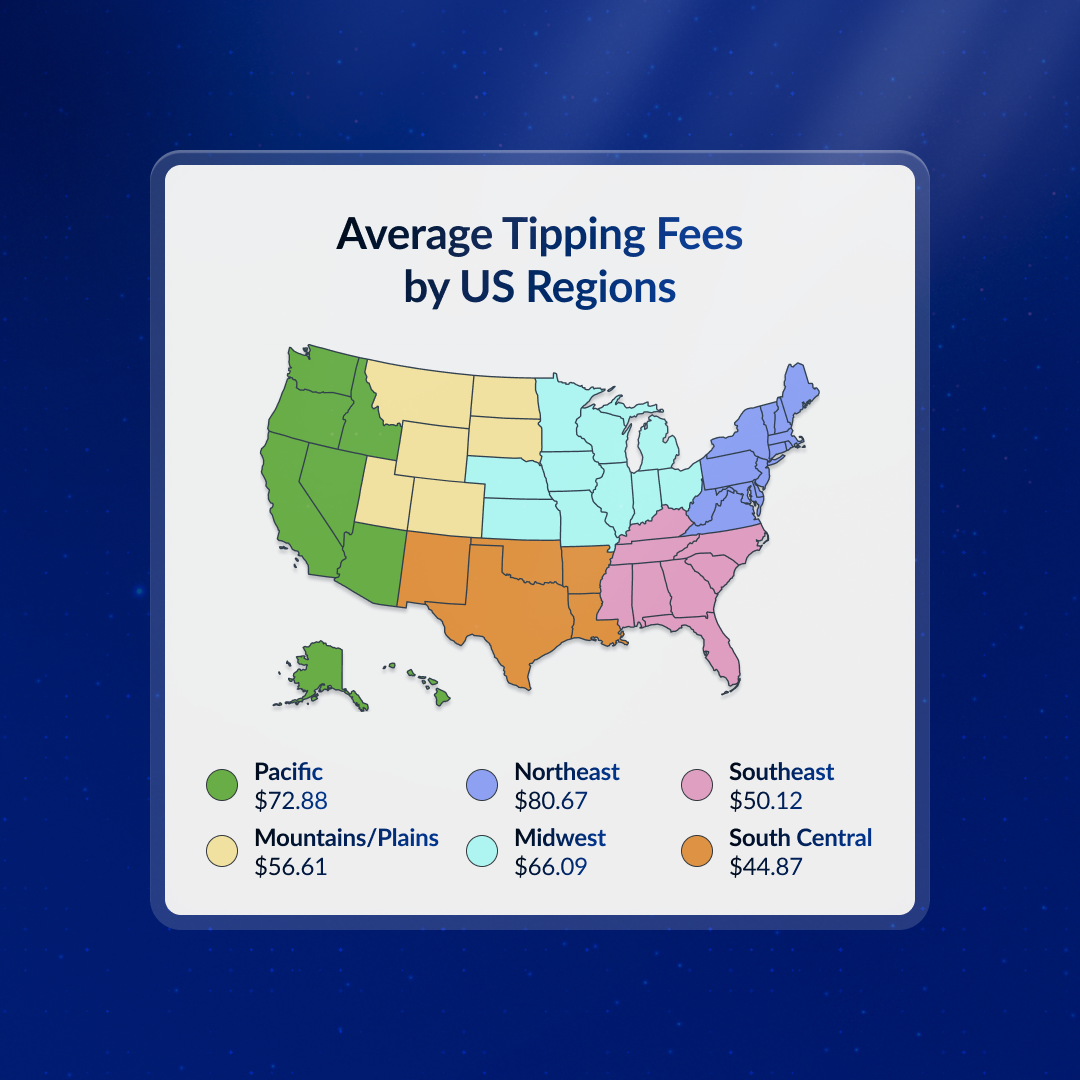
The report also broke down tipping fees by designated regions of the country (see below). Of the six regions, four had unweighted tipping fee increases of at least 10% in 2024, with the Northeast and South Central areas actually experiencing decreases1. With the Pacific region seeing an increase of greater than 15% ($62.28 to $72.88)1.
Similar Fees for C&D and MSW Disposal
The report also concluded that tipping fees for construction and demolition (C&D) waste is not statistically higher than those of municipal solid waste (MSW)1. In fact, 79% of the landfills surveyed have tipping fees for C&D waste either equal to, or less than MSW tipping fees1.
What These Trends Mean for Dumpster Rental Business Owners
Success in the dumpster rental industry can be boiled down to two things:
- Knowing how much it costs you to rent a dumpster
- Knowing how much you make from renting a dumpster
And tipping fees are a key factor in the profitability equation since they directly affect your overhead costs and will indirectly determine where you price your rentals. This means that tipping fees should be something that you are consistently monitoring.
As the EREF report highlighted, tipping fees are generally increasing and can vary greatly by landfill size and location. This can represent a challenge for the business owner trying to optimized overhead costs with the ultimate goal of having healthy, predictable, and reliable revenue streams for their rental business.
Strategies that can be used to keep tipping fees low and stable include:
- Negotiate a contract rate for fees
- Favor medium-sized landfills
- Optimize for waste type, C&D vs. MSW
- Use cost tracking software
Track Tipping Fees and More with Dumpster Rental Software
If you want to streamline tracking and managing tipping fees, fuel, storage, and other overhead costs, Dumpster Rental Systems is a smart investment to boost your business’s efficiency and profitability.
Our all-in-one, cloud-based software was designed specifically for the dumpster rental industry and offers several high-value features including:
- Online 24/7 booking
- Real-time tracking
- Customer Relationship Management system
- Performance dashboard
- Built-in marketing tools
Ready to master tipping fees and boost your profit margins? Contact our sales team today and start transforming your business.
Frequently Asked Questions
What Are Tipping Fees and Why Do They Matter for Dumpster Rental Businesses?
Tipping fees are the charges a landfill costs to dump waste, typically priced by weight. Tipping fees are a major overhead cost for dumpster rental businesses since they will have to pay a tipping fee for every rental they complete. Tracking and optimizing tipping fees is key to optimizing overhead costs and profit margins.
Are Construction and Demolition Tipping Fees Higher Than Municipal Solid Waste Tipping Fees?
According to the 2025 report by the Environmental Research and Education Foundation, construction and demolition (C&D) tipping fees are not statistically higher on average than those of municipal solid waste (MSW). Some landfills may charge more or less to dump C&D waste.
What Role Does Software Play in Managing Tipping Fees and Overall Business Costs?
Software allows dumpster rental business owners to easily track tipping fees and other overhead costs like fuel and labor in real-time. It is an essential tool for identifying cost trends at early stages, accurately pricing dumpster rentals, maximizing margins, and making data-driven decisions that drive growth.
References
- The Environmental Research & Education Foundation (2025). “Analysis of MSW Landfill Tipping Fees — 2024.” Retrieved from www.eretdn.org.