TL;DR
- Margins grow through small wins: longer tire life, less fuel waste, faster turnarounds — not one “big” fix
- Roll-off work eats tires: heavy loads, stop-and-go driving, tight turns, and jobsite/landfill hazards.
- Neglect gets expensive fast: high tire prices, worse fuel economy, extra wear on parts, and downtime that kills revenue.
- Protect your tire investment: keep PSI optimal, use sealants, rotate on a schedule, and track install dates and tread wear.
Small Wins Grow Margins
The reality is that growing your bottom line comes from stringing together small, boring wins:
- More life out of your tires
- Less wasted fuel
- Faster turn-around time
Individually, none of those are huge wins by themselves. But together, they can be the difference between constantly chasing cash flow and finally feeling like your business is steadily growing.
This article is Part 1 in our “Optimizing Overhead” series, where we break down the less-visible costs that quietly eat away at your profits and show you strategies on how to optimize each one within your current operation.
We’re starting with one of the most underrated money burners in dumpster rental:
Tires.
Read on to see how tire problems can cut into your profits and the practical steps you can take to optimize this line item in your operation.
How Tire Problems Turn Into Profit Problems
You’ve bought the truck.
You’ve invested in dumpsters.
You’ve paid for insurance and secured a yard to store everything.
Just getting your dumpster rental business off the ground can cost hundreds of thousands of dollars.
Getting started is expensive, but simple. Staying profitable is the hard part.
Because once you’re actually running routes, the hidden costs show up fast: fuel, repairs, dump fees, and yes, tires.
The best way to sum up the importance of tires is:
- Your entire business is delivering and picking up containers with your truck.
- Your truck runs on tires.
Truck tires are expensive. And it should come as no surprise that hauling dumpsters is especially hard on them.
Although, tire spend is unavoidable, it is something that you can keep in check.
So staying ahead of tire wear and damage should be part of a strategy to optimize overhead and consumables costs. Otherwise, you won’t just buy more tires, you’ll end up losing revenue.
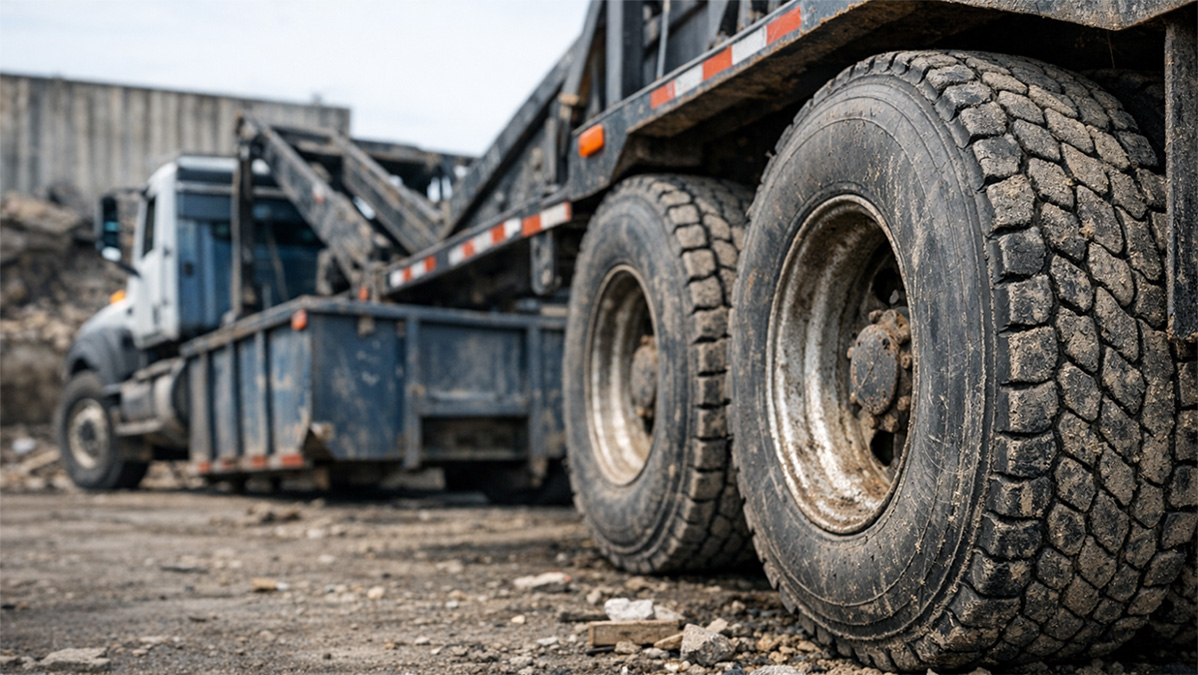
But before you can control those costs, you should be aware of why tires take such a beating in the dumpster business.
Why Tires Take a Beating in the Dumpster Business
An empty 15-yard dumpster weighs roughly 4,700–5,000 lbs (depending on style). For context, a regular sized car is typically in the ~2,551–3,055 lb weight range.
So even before you factor in a dumpster that is loaded with debris, you’re already dealing with serious weight on a vehicle. And that weight combined with the stop-and-go, multiple turn driving that trucks will be doing to drop off or pick up a dumpster will wear down your tires fast.
A few of the factors in the dumpster hauling industry that compound tire wear and tear include:
- Stop-and-go under heavy weight: Your routes will typically be stop-and-go driving that stresses tires more than moving at a cruising speed.
- Higher road hazard exposure: You’re often driving through construction zones where you’re more likely to drive over nails, screws, and other road hazards that can puncture your tires. Even when you’re not servicing a construction zone, all of your jobs will involve driving to a landfill or transfer station where other operators will bring these road hazards to you.
- Tight turns cause tire scrub: Roll-off trucks are “specialized” vehicles, so they move differently. When a truck has to make a tight turn, its tires aren’t able to roll in a clean arc and they may have to slide across the surface to enable the truck to complete the turn; Under a heavy load that sideways friction chews up tire tread fast, particularly on hard surfaces like asphalt and concrete.
All of these factors together should make it easy to see how roll-off work eats through tires faster than “regular” delivery driving. It’s not random. It’s the combination of weight, surfaces, and the way these trucks are maneuvered all day.
Tires Are Expensive — And the Costs Go Beyond Rubber
Tire replacement is a normal part of vehicle ownership. What isn’t normal is how fast tire costs can stack up in the roll-off rental business, and how neglecting your tires can eat into your margins.
Protecting your bottom line starts with understanding how small tire issues can become bigger costs over time.
Here are 4 ways that tire neglect can cost your business:
Premature Replacement Gets Expensive Fast
For a Peterbilt 567 (a common vocational chassis for roll-off builds), premature tire replacement is expensive because new mid-range tires will cost ~$300 – $600 a tire with premiums costing in the $1,000 range. Keep in mind that 10 tires (not four) typically make up a full set for your truck. This means that each time you replace a complete set it will cost you between $4,000 and $8,000.
This is why the goal is to get every mile you can out of the tires you’ve already paid for because premature wear is a direct hit to cash flow.
Underinflated Tires Quietly Drain Your Margins Over Time
One of the “quietest” profit drains is underinflation. Low pressure increases rolling resistance and heat, which accelerates wear and shortens tire life. It rarely feels urgent day to day, but over months it adds up to more frequent replacements and a tire bill that’s higher than it needs to be.
Tire Neglect Can Wear Down Other Parts of Your Truck
When tires are neglected, this can create a ripple effect that wears down the other parts of your truck. Poor inflation, uneven wear, and misalignment can increase stress on suspension and steering components and contribute to accelerated degradation to parts that are expensive to replace. A small tire issue can turn into a bigger maintenance problem when the rest of the truck is forced to compensate.
Downtime Costs You Today’s Route — And Tomorrow’s Jobs
The biggest direct cost shows up when your truck isn’t running. Tire issues leading to a breakdown or unexpected shop visit will be more expensive than just the repair bill. They can mean missed drops, delayed pickups, and revenue that can’t be recovered.
If you’re a single truck operator, one day of downtime can disrupt your entire schedule, push jobs back, frustrate customers, and cost you bookings at the stage that you need them most.
How to Make Your Tires Last Longer (And Protect Your Margins)
Tire wear in the roll-off business isn’t completely avoidable, but it is manageable. Optimizing your margins is about controlling the preventable causes of early wear and failure.
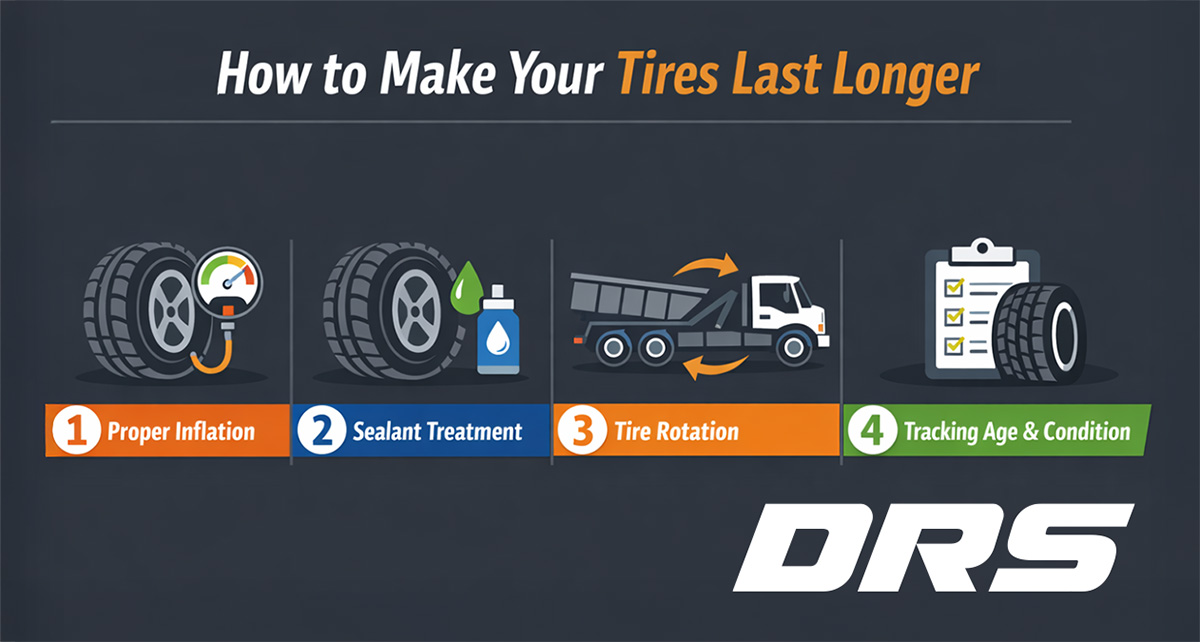
These are 4 ways to help you get the most out of your tires:
Keep Tires Properly Inflated
It sounds basic, but any strategy to extend the life of your tires has to start with maintaining proper tire pressure.
Underinflated tires cause the side walls to stretch, which expands the contact surface between the rubber and the road. More contact means more friction, which means more heat.
That extra heat degrades the internal tire structure, accelerates tread wear, and shortens tire life.
With roll-off dumpsters, this effect can be more intense because you are almost always driving under some kind of load.
Tire underinflation also makes the engine work a lot harder to move the same amount of weight, which reduces fuel economy.
Roll-off operators should be checking tire pressure weekly at a minimum. When you’re a smaller operation this is easy to manage, but some larger or high-mile operators invest in automatic tire inflation systems that monitor and maintain proper PSI while the truck is in operation. These systems reduce the risk of chronic underinflation and can extend tire life by maintaining consistent pressure.
Tire replacement is inevitable, whether they are properly inflated or not. However, if you’re at least maintaining properly inflated tires, you won’t be replacing them early due to something preventable.
Treat Your Tires With a Sealant
In roll-off work, you’re constantly driving through construction sites, demolition debris, and rough ground. Nails, screws, and sharp scrap are part of the job, which means tire punctures are as well.
Some experienced operators reduce puncture-related downtime by using commercial tire sealants inside their tires. These sealants are thick liquids that coat the inside of the tire. When a nail or screw causes a small puncture, the liquid can help seal it and slow or stop air loss before the tire drops to a damaging pressure level.
Sealants won’t eliminate tire problems, but they can reduce slow leaks, help you avoid periods of underinflation and road service calls.
Rotate Tires on a Schedule
Roll-off trucks don’t wear tires evenly.
With drive and steer tires, tandem rear axles, tight turns, heavy loads, and frequent stops, your tires are going to bear weight differently. Over time, that leads to uneven wear, between tires in different positions (front vs. rear, inner vs. outer).
If tires stay in the same position their entire life, some will wear out sooner than others. That means replacing a few tires early while the rest of the set still has life left.
Rotating tires helps to even out tread wear over time. Again, the goal isn’t to avoid replacement, it’s to extend the overall life of the set and avoid burning through individual tires too soon.
Rotation also helps expose developing issues. Uneven wear patterns can signal alignment problems, suspension wear, or inflation inconsistencies. Catching those early prevents bigger repair bills later.
For many operators, rotation becomes part of a regular maintenance routine for a certain mileage or time of year. The exact schedule will vary by operation, but the principle stays the same: distribute wear evenly, replace tires predictably, and avoid early replacement.
Track Install Dates and Tread Wear
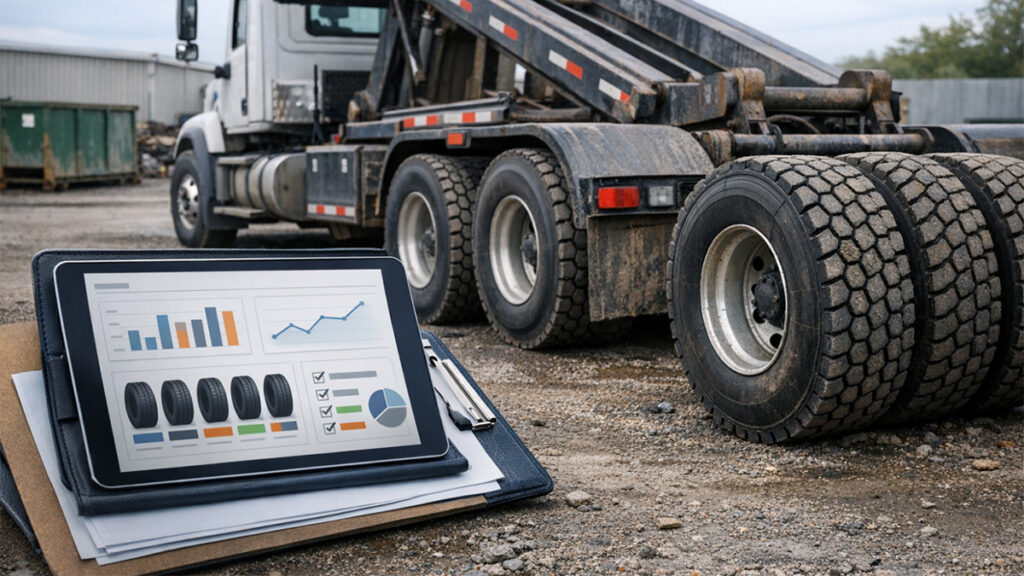
If you’re going to invest thousands of dollars in a full set of tires, you should track how long they actually last in your operation.
Tracking install dates gives you a reference point. Without it, you’re guessing whether a tire lasted six months or fourteen. When you record the install date, truck number, and tire position, you create a simple performance history you can reference later.
Monitoring tread wear is just as important. Uneven tread patterns can signal underinflation, alignment issues, or suspension problems long before they turn into bigger maintenance costs. Catching those patterns early helps you fix the root cause instead of just replacing rubber.
Documentation also protects warranty and road hazard coverage. Many commercial tire programs require proof of installation, maintenance, and tread depth at time of failure. If you don’t have records, recovering money from a premature failure becomes harder.
Tracking your tires’ lifecycle doesn’t have to be complicated. A simple log that tracks install date, tire position, rotation history, and periodic tread photos will pretty much cover everything.
Optimizing Costs Requires Visibility
Tires are just one line item in a roll-off operation. For some operators, they represent five percent of total expenses. For others, more.
But the takeaway isn’t that tires are the biggest cost, it’s that they are a controllable one.
Practices like proper inflation, regular rotation, and the use of sealants are just a few ways to extend the life of your tires.
But operating a successful roll-off dumpster business isn’t just about extending tire life, it’s about optimizing your entire operation. And to do that, you need reporting that tracks:
- How much you’re paying for tires
- How long they’re lasting
- What your fuel economy is
- What your cost per mile is
Dumpster Rental Systems (DRS) was built specifically for roll-off operators who want that level of insight so they can use reliable data to guide decisions instead of guesswork.
And DRS isn’t just for reporting. It also helps streamline the customer-facing side of your business with features like:
- Online booking
- Integrated payments
- Website templates
- Marketing tools
With DRS software, you can measure performance, spot trends early, reduce costs, and keep profitability predictable as you grow.
If you’re interested in making overhead easier to measure and manage, book a demo to see how DRS can help optimize your operation.